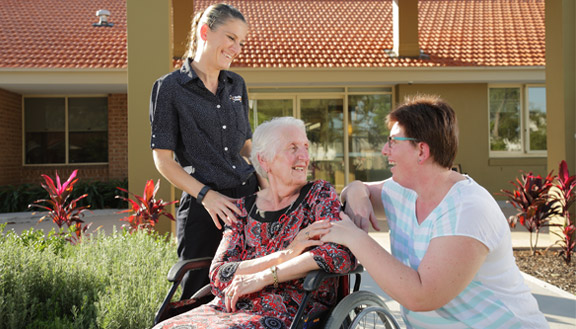

We provide residential care to help meets the needs of those older people who require assistance in their day to day living activities, including personal care, meals, cleaning etc.
Our facilities provide for ageing-in-place offering both low-care (formerly called Hostel or assisted living) and high-care (formerly called Nursing Home) services. All facilities are fully accredited by the Aged Care Standards & Accreditation Agency.
All applicants for our supported living apartments must be assessed by an Aged Care Assessment Team (ACAT) as requiring residential care services.
Please refer below for more information on our residential care services.
| 1. |
What are residential care services? |
| |
Residential care helps to meet the needs of those older people who can no longer live at home. Usually they will require assistance in their day to day living activities , including personal care, meals, cleaning etc. We operate a range of ageing-in-place low-care (formerly called Hostel or assisted living) to high-care (formerly called Nursing Home) facilities providing a range of care/support services. The services will vary depending upon the needs of the individual resident, but can include -
- Accommodation and utilities (eg electricity & water)
- Maintenance of buildings and grounds
- Meals and refreshments (including 3 meals per day plus morning tea, afternoon tea & supper)
- Laundry and cleaning services
- Personal assistance including individual attention, individual supervision and physical assistance with:
- bathing, showering, personal hygiene and grooming
- maintaining continence or managing incontinence and using aids and appliances designed to assist continence management
- eating and eating aids and using eating utensils and eating aids (including actual feeding if necessary)
- dressing, undressing and using dressing aids
- moving, walking, wheelchair use and using devices and appliances designed to aid mobility, including the fitting of artificial limbs and other personal mobility aids
- communication including to address difficulties arising from impaired hearing, sight or speech, or lack of common language (including fitting sensory communication aids), and checking hearing aid batteries and cleaning spectacles.
- Note that residents assessed as requiring high care may also receive more extensive support services including access to special bedding materials, some toiletries and pharmaceuticals, mobility aids and nursing care.
The full range of services is listed in our Information Sheets which are available on request (see Q. 22).
|
| Top |
| 2. |
Who can use these services? |
| |
Older people or people with a disability can use these services if the services are assessed as being appropriate for the person's needs
Before anyone can move into a SCC Residential Care Facility their health, social and personal needs must be assessed by an Aged Care Assessment Team (made up of health professionals).
Most people are referred to an Aged Care Assessment Team directly by their doctor, community nurse or social worker but if they wish they may approach their nearest Team directly (through their local hospital, the State Health Department or the Commonwealth Department of Health and Ageing - control click on link to see information www.health.gov.au).
After visiting and talking with the person the Team assesses whether they are eligible for residential care or there are other options more suited to their needs. If residential care seems appropriate the Team will decide on the level of care required (either high or low level care) and then issue a written assessment that confirms this requirement.
|
| Top |
| 3. |
How do they gain entry to the service? |
| |
Once the person has an ACAT assessment confirming their need for residential care services they may register their interest in one or more facilities. Intending residents will need to complete and forward an Application for Respite Care or Permanent Entry to an Aged Care Home.
The application form seeks information regarding the applicant's personal circumstances, needs and preferences. This advice will help inform our care team in their assessment of that application, and help ensure that any offer of care services & accommodation is appropriate for the needs of the intending resident.
Further information is available on the Commonwealth Department of Health and Ageing website.
|
| Top |
| 4. |
Is there a waiting list? |
| |
There isn't a waiting list. The accommodation is allocated on the basis of needs to help ensure that the care services are directed to those requiring the most support. However, intending residents should certainly forward their details confirming their interest in entering the accommodation so that their needs may be considered when any vacancies are being allocated. |
| Top |
| 5. |
How long do they have to wait before they can move into the accommodation? |
| |
Once a prospective resident has an ACAT assessment (see Question 2 above) there isn't any guaranteed waiting time. When an appropriate vacancy arises Southern Cross Care will offer that accommodation to the person with the greatest identified need. Where we have multiple services in an area prospective residents can help minimise their waiting time by registering their interest in a number of those local services BUT it is important that you tell us if you no longer wish or need to remain on the list. |
| Top |
| 6. |
What will it cost to enter the supported living apartments? |
| |
Subject to individual assessment, people requiring low-care services may have to pay an accommodation bond on entry to the accommodation. Those people requiring high care services may have to pay an accommodation charge.
The Accommodation Bond is a sum of money paid by low-care residents, which can be used by SCC to maintain and improve its care facilities. The amount of Accommodation bond paid, and refunded on departure, will always comply with the provisions of the Aged Care Act.
On entry all low-care residents must pay a bond unless they have assets below the threshold set down in Commonwealth legislation legislation, or they have been living in a SCC Independent Living Unit, or.
The bond amount is determined on an individual basis. The Aged Care Act has placed no ceiling on Accommodation bonds, however SCC treats every Resident as an individual, and therefore will always negotiate a bond, which is fair and affordable. As the first step in this process we ask that all residents complete a Statutory Declaration.
The resident will be asked to pay the full bond amount unless they lack the capacity to do so.
The Aged Care Act stipulates that each Resident must be allowed to retain assets worth at least two-and-a-half times the annual aged pension. The Act allows for the Accommodation Bond to be reduced or waived if paying the Bond would leave you with assets below this threshold).
However, if the resident is seeking such concessional status the Act requires that verification of financial status must be obtained through Centrelink and/or the Department of Veterans Affairs.
People entering high level (nursing home) care may be required to pay an accommodation charge. These funds can be used by SCC to maintain and improve its care facilities.
The accommodation charge is separate from daily fees. The extent of the charge is set by the Aged Care Act and determined by the value of the Resident's assets The Department's website holds further information.
For current residents of any residential care facility transferring to another SCC Residential Care Facility, we can negotiate that the bond already paid will transfer across, and the retention period (if any) will carry over. In other words, the bond and the retention arrangements continue as though the transfer did not take place and no accommodation charge will be levied.
|
| Top |
| 7. |
How much will it cost in terms of ongoing fees? |
| |
Every resident of a Care Facility pays fees as a minimum equivalent to 85% of the Aged Pension (base fee). The level of those fees is established by individual assessment in keeping with the policy requirements of the Department of Health and Ageing under the Aged Care Act (1997). These care fees are in addition to any entry contribution negotiated The Department's " target="_blank">website holds further information.
Fees are paid fortnightly in advance from the 'Date of Entry' on your signed agreement.
There are two types of daily care fees for all permanent residents entering our care facilities, and we determine fees payable based on the income information provided (ie. a statement from Centrelink/Dept of Veteran Affairs).
- base daily care fees that all residents must pay from the first day of entry; and
- income-tested care fees for part-pensioners and non-pensioners payable after the first 28 day 'period of grace'.
There are some exceptions to income-tested fees. These include some former prisoners of war whose fees are paid by the Department of Veterans' Affairs. As well, residents in the lowest care category (category 8), and residents with dependent children will also not pay an income-tested fee.
|
| Top |
| 8. |
How are those fees paid? |
| |
Ongoing fees are paid on a fortnightly basis via direct-debit. |
| Top |
| 9. |
Are there any other costs? |
| |
While many services are covered under the ongoing care fees, there are other optional services that are available on a fee-for-service basis eg in-house hair dresser, some social activities and outings, staff assistance in attending external medical appointments. |
| Top |
| 10. |
What is the accommodation like? Do the rooms have ensuites? |
| |
The vast bulk of our accommodation is provided as bedsitter apartments with attached ensuites, clustered around shared Living & Dining facilities. Some of the high care accommodation is still provided in shared rooms, with the majority being twin-share. Site-specific information can be provided on enquiry. |
| Top |
| 11. |
Is there room for a refrigerator? |
| |
The majority of our new or refurbished apartments do have space for a small refrigerator, but the accommodation varies so this would have to be confirmed on an individual facility basis. Note that the cleaning and maintenance of that refrigerator remains the responsibility of the resident. |
| Top |
| 12. |
Can a resident keep their own GP? |
| |
A resident can access the GP of their choice. |
| Top |
| 13. |
Can a resident use their own Chemist? |
| |
A resident can use their own Chemist only if the resident is able to self-medicate. |
| Top |
| 14. |
Can a resident manage their own medications? |
| |
A resident can manage their own medications if they have been assessed by their Doctor and clinical care staff as capable of doing so. |
| Top |
| 15. |
Can residents have visitors? |
| |
The supported living apartment is the resident's home. As such there are no restrictions on visitors, as long as the comfort and privacy of other residents is not disturbed. Note also that security is higher after hours and on weekends, but visitor access is still available. |
| Top |
| 16. |
Can residents leave the facility for holidays, etc? |
| |
A resident may be absent from the Care Facility for 52 nights in a financial year on 'social leave' (leave distinct from time spent in hospital). During these absences the resident must continue to pay their normal fortnightly fees.
If the leave exceeds the 52 nights Southern Cross care will lose any government funding for that excess period. To secure the resident's place in the facility they will need to pay an amount equivalent to the lost subsidy in addition to the normal fortnightly fees.
|
| Top |
| 17. |
Can a resident have a pet? |
| |
Individual pets are NOT allowed given the shared nature of the accommodation. |
| Top |
| 18. |
What if a resident's needs change? |
| |
Southern Cross Care is committed to providing each resident with quality care and services, within a relaxed, community atmosphere. We also support the concept of "ageing in place", whereby we are attune to each Resident's needs, and strive to assist Residents if these care needs increase.
Unfortunately, if a residents needs should change significantly we cannot promise that we will be able to provide the level of care and services they require in the same Care Facility.
In these situations we will endeavour to transfer the resident to another SCC Facility which will better meet their needs. However, the resident (or family) may choose to transfer to a facility operated by another provider.
|
| Top |
| 19. |
Can a resident leave the facility to live somewhere else? |
| |
A resident can choose to leave our accommodation and move elsewhere - to another SCC Facility, another provider's Care Facility, or somewhere else in the broader community. |
| Top |
| 20. |
When is an Accommodation Bond refunded? |
| |
Southern Cross Care will refund the balance of the Accommodation Bond if a person ceases occupancy in a SCC Facility.
The bond balance will be refunded within the timeframe specified in their Resident Agreement, a period consistent with that provided for in the Aged Care Act, with the following deductions -
- A Retention amount calculated in keeping with the Act
- Any interest deducted for late payment of the Accommodation Bond.
- Any other amounts you owe to SCC under your Resident Agreement.
The refund is calculated in keeping with the requirements of the Commonwealth Aged Care Act
|
| Top |
| 21. |
Where can I get more information? |
| |
Further information is available through -
- Contacting Southern Cross Care on 02 9632 3144. An information pack can be forwarded if required.
- Your Doctor or local hospital
- The local Aged Care Assessment Team LINK
- The Australian Government Seniors website LINK
- The Commonwealth Department of Health and Ageing residential care website at LINK
|
| Top |